$ cat README.md
Real-Estate Developer Website
3D City Concept Site for a Mumbai Real-Estate Developer
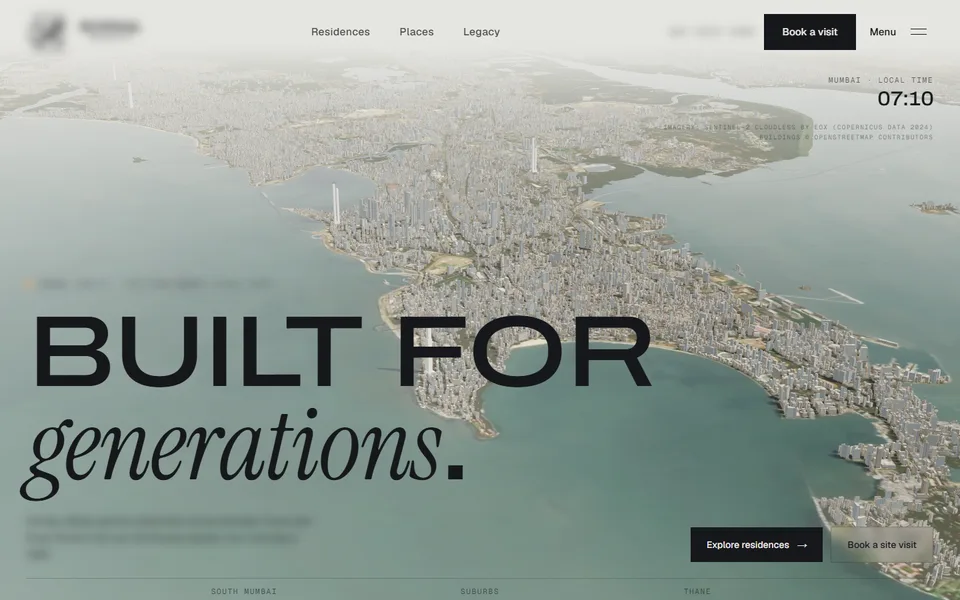
A concept site for a Mumbai real-estate developer that opens above a 3D city: satellite Mumbai in three.js, a scroll flight across the regions, a 3D enquiry flow and building-rise page transitions. Designed and built end-to-end by Shreyash Tripathi, a Full-Stack Developer and UI/UX Engineer based in Noida, India.
How it's built
- 013D satellite Mumbai (Sentinel-2 + OpenStreetMap)
- 02Scroll flight across the city's regions
- 03Residences: map finder + tower explorer
- 043D enquiry flow: your floors light up
- 05Legacy time machine + NRI globe
- 06Building-rise page transitions
Overview
A concept website for a Mumbai real-estate developer with decades of projects across Mumbai, Thane and Pune. The goal was a site that feels like the city it builds in: you arrive above a 3D Mumbai and fly down to the neighbourhoods where the homes are.
Shreyash Tripathi designed and built it on his own in Next.js 16 with React Three Fiber, three.js, MapLibre, GSAP and Lenis: 16 routes, 80 components and about 24,000 lines of TypeScript.
How it works
A real city as the hero
The home page opens on a 3D Mumbai built from Sentinel-2 satellite imagery and OpenStreetMap buildings, with custom GLSL colour grading and a live Mumbai clock. Google Photorealistic 3D Tiles load only when an API key is set and the device can handle them.
Fly through the regions
Scrolling flies the camera from South Mumbai to the suburbs and Thane, with each region's story and addresses appearing as you arrive.
Find a residence
A residences browser with segmented filters, a MapLibre map finder, a 3D tower explorer with floor bands, and "see it at any hour": one render re-lit live from sunrise to late night, with windows switching on through the evening.
A 3D enquiry flow
Booking a site visit is four steps: residence, home, visit and details. Choosing a residence raises its tower in 3D, and your home type and budget highlight the band of floors that fits.
Legacy and NRI pages
A draggable time machine that snaps to milestones, a family tree of projects, and for overseas buyers a 3D globe of the cities they write from, with live world clocks showing the gap to Mumbai time.
Details that feel like a building
Page changes are a building going up: slats rise floor by floor with a floor counter, then lift away. On phones the menu is a lift panel, top floor first.
Everything else a developer site needs
Insights magazine with article pages, searchable FAQ, investor document library, careers openings, CSR causes, a loyalty-benefits calculator and a draggable strip of the brand's latest social posts.
Challenges & solutions
challenge: A whole city in 3D is heavy for phones and mid-range laptops.
solution: Satellite imagery and OpenStreetMap buildings render by default; the photorealistic 3D tiles are lazy-loaded only when the device can take them. Per-frame values like the hour and globe rotation are written straight to the scene or the DOM, never through React state.
challenge: The night skyline needed real building heights without loading map data at runtime.
solution: A Python script bakes OpenStreetMap building heights into a small data file, which the night skyline draws as a grid of lit windows.
challenge: A design-heavy site can break on small screens: overflow, tiny labels, sticky elements in the way.
solution: Every screen got a pass: a 13.5px minimum text size from tablets up, no horizontal overflow, stacked labels, non-sticky filters on phones and a compact lift-panel footer.
Results
- 16 routes, including prerendered residence and article pages.
- 80 components and about 24,000 lines of TypeScript, built solo.
- Works on phones with a dedicated lift-panel menu and mobile layouts.
What I built
- 3D satellite Mumbai from Sentinel-2 imagery and OpenStreetMap buildings
- 3D enquiry flow, residence map finder and tower explorer
- 16 routes, 80 components, about 24,000 lines, built solo
Tech stack
Real-Estate Developer Website is built with Next.js 16, React Three Fiber, three.js, MapLibre, GSAP, Lenis and TypeScript.
- Next.js 16
- React Three Fiber
- three.js
- MapLibre
- GSAP
- Lenis
- TypeScript

About the developer
Shreyash Tripathi is a Full-Stack Developer and UI/UX Engineer in Noida, India, currently Junior Developer, UI/UX at Garage Collective. He builds React, Next.js and TypeScript interfaces for AI-integrated SaaS products.