$ cat README.md
Finance Mobile App
React Native Finance App for Service Businesses
An Android app where founders and finance teams see revenue, cash and risk per client, and approve bills and payments in one tap. Designed and built end-to-end by Shreyash Tripathi, a Full-Stack Developer and UI/UX Engineer based in Noida, India.
How it's built
- 01Sign in + biometric app lock
- 02Role-based home (5 roles)
- 03Finance inbox: swipe to approve
- 04Live API + encrypted offline cache
- 05Invoice PDFs and reminders
- 06Push notifications + home-screen widgets
Overview
A read-first Android companion app for a client-profitability and cash platform used by service businesses. Founders and finance leads use it to see revenue, cash and risk client by client, know who owes what, and approve bills, payments and reimbursements in one tap.
Shreyash Tripathi built the app on his own, from the first screens through live data, roles, quick actions, push notifications, app lock, home-screen widgets and a security audit, shipping 15 versions in under two weeks.
How it works
Role-based homes
Five roles (admin and finance manager, department head, accountant, employee and more) each get their own home screen, with demo accounts to switch between.
Finance inbox
A mail-style approvals inbox sorted by urgency, with swipe-to-approve, multi-select and a card-by-card Review mode.
Money and clients
Overdue invoices grouped by client, a needs-attention carousel, client ledgers and invoice PDFs with a GST breakdown.
Reminders
Invoice reminder stages at 15, 30 and 45 days, plus daily, tax-deadline and festival reminders and push notifications.
Widgets
Six Android home-screen widgets: Approvals, Next deadline, Quick actions, Collections, My requests and Today.
Security
Certificate pinning, an encrypted offline cache and widget data (XChaCha20-Poly1305), biometric app lock, blocked screenshots and a rooted-device warning.
Challenges & solutions
challenge: The home-screen widgets never drew: the React Compiler rewrote components in a way that broke when the widget library called them as plain functions.
solution: Opted the widget files out of the compiler. Test renders went from 0 of 216 working to 216 of 216.
challenge: The app crashed at startup because the PDF library needs a text decoder the Hermes engine doesn't have.
solution: Wrote a small polyfill and loaded the PDF code only when an invoice PDF is first requested.
challenge: Each role sees and can do different things, and edge cases slip through: acting on already-decided requests, financial-year maths in January to March, cache-restore races.
solution: Ran a full role audit and fixed 40 issues in one pass, then hardened security in the next release.
Results
- Shipped to testers as an Android APK, versions 1.0.1 to 1.0.15.
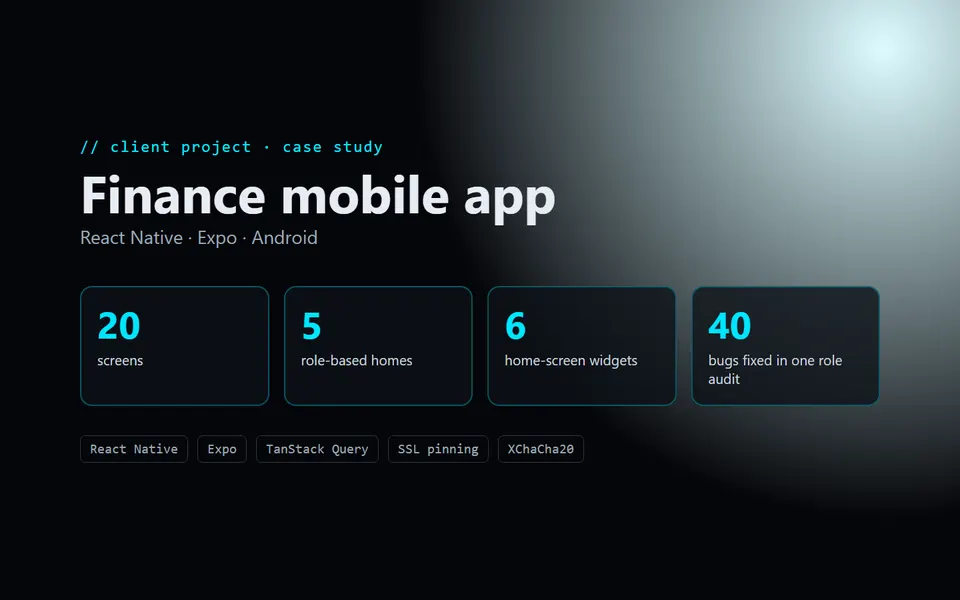
- 20 screens, 5 role-based homes and 6 home-screen widgets.
- APK size cut by building only phone CPU architectures and enabling R8 code shrinking.
What I built
- Built solo: 20 screens, 5 role-based homes, 6 widgets.
- Swipe-to-approve inbox, invoice PDFs, offline mode.
- Security hardening: pinning, encrypted cache, biometric lock.
Tech stack
Finance Mobile App is built with React Native, Expo, TypeScript, TanStack Query, SSL pinning and Android widgets.
- React Native
- Expo
- TypeScript
- TanStack Query
- SSL pinning
- Android widgets

About the developer
Shreyash Tripathi is a Full-Stack Developer and UI/UX Engineer in Noida, India, currently Junior Developer, UI/UX at Garage Collective. He builds React, Next.js and TypeScript interfaces for AI-integrated SaaS products.