$ cat README.md
goredis
Redis-Inspired In-Memory Database in Go
A Redis-compatible key-value server written from scratch in Go, with TTLs, crash-safe AOF persistence, Prometheus metrics, Docker, Kubernetes and CI. Designed and built end-to-end by Shreyash Tripathi, a Full-Stack Developer and UI/UX Engineer based in Noida, India.
How it's built
- 01redis-cli / any Redis client
- 02TCP + RESP2 parser
- 03Command engine
- 04In-memory store + TTL heap
- 05Append-only file (group commit)
- 06Prometheus metrics → Grafana
Overview
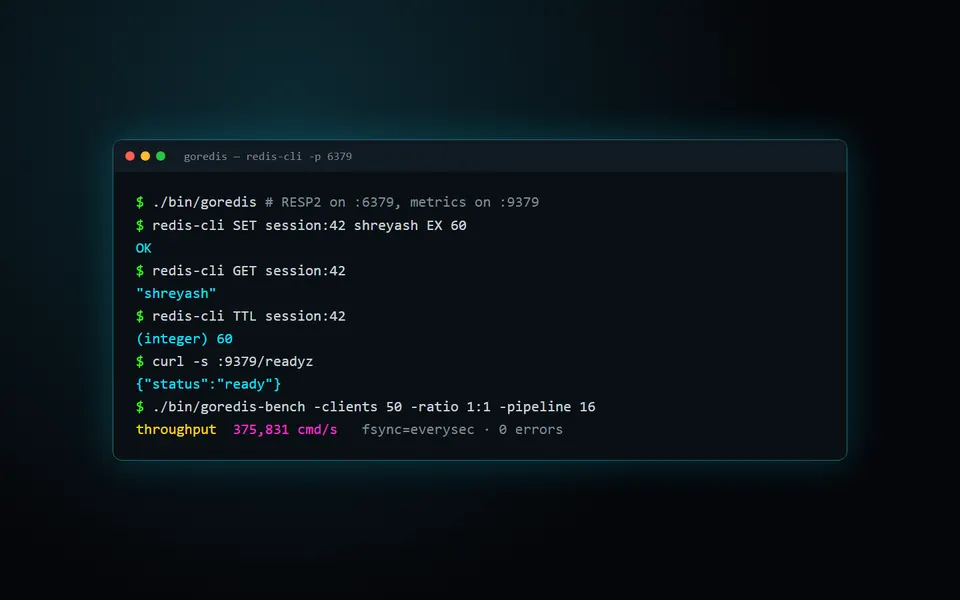
goredis is a Redis-inspired, in-memory key-value server written from scratch in Go. It speaks the Redis wire protocol (RESP2) over TCP, so redis-cli and standard Redis client libraries work with it for the commands it supports.
Shreyash Tripathi built it solo as a systems project: the protocol parser, the command engine, the storage layer with expiry, crash-safe append-only-file persistence, and the full production setup around it (metrics, health probes, Docker, Kubernetes, CI, dashboards and incident runbooks).
How it works
Protocol
A RESP2 parser and encoder over TCP with pipelining and inline commands, plus request size limits so a malformed or oversized request can't exhaust memory.
Commands
21 Redis commands, including SET with EX, PX, EXAT, PXAT, NX, XX, KEEPTTL and GET, EXPIRE with NX, XX, GT and LT, TTL, PERSIST, AUTH, SELECT and BGREWRITEAOF.
Storage and expiry
A map guarded by a read-write lock, with exact TTLs (an expired key is never visible), a min-heap so DBSIZE excludes expired keys cheaply, and one bounded background sweeper.
Persistence
An append-only file with always, everysec or no fsync, group commit, safe recovery from a crash mid-write, AOF rewrite for compaction, an OS file lock against two writers, and a repair tool.
Operations
Structured logs, Prometheus metrics, health and readiness endpoints, graceful shutdown, password auth, protected mode and maxmemory, with a Grafana dashboard, alerts and incident runbooks.
Delivery
A multi-stage, distroless, non-root Docker image; Kubernetes manifests with a persistent volume, probes, NetworkPolicy and a security context; and GitHub Actions CI that builds, scans and deploys to a test cluster.
Challenges & solutions
challenge: A crash in the middle of a write can leave a half-written record at the end of the append-only file, and blindly loading it would corrupt the data.
solution: Recovery detects a truncated final record and loads everything before it, refuses to load files that are corrupt elsewhere, and ships a goredis-check-aof tool to repair them.
challenge: fsync on every write is durable but slow: each acknowledged write waits for the disk.
solution: Group commit batches concurrent writes into one fsync. Measured under the always policy, 449,756 writes needed only 59,752 fsyncs, about 7.5 writes per fsync.
challenge: Expired keys must never be returned, but scanning the whole dataset to delete them is expensive.
solution: Every read checks expiry exactly, while a min-heap tracks the next keys to expire so one bounded background sweeper and DBSIZE stay cheap.
Results
- 137,509 commands/s for a 1:1 GET/SET mix, and 375,831 commands/s with pipelining (everysec fsync, 50 clients, 2-vCPU Linux CI runner).
- 21 Redis commands working with redis-cli and standard client libraries, about 7,300 lines of Go, with unit, fuzz, integration and end-to-end tests.
- CI builds and smoke-tests the Docker image (0 known vulnerabilities in the scan) and deploys the Kubernetes manifests to a test cluster, checking auth, probes and data surviving a pod restart.
What I built
- Built a Redis-compatible server in Go: 21 commands, TTLs and append-only-file persistence with group commit.
- Measured 137k commands/s (375k/s pipelined) on a 2-vCPU Linux runner.
- Shipped with Prometheus metrics, a Grafana dashboard, Docker, Kubernetes manifests and CI.
Tech stack
goredis is built with Go, RESP2 / TCP, Prometheus, Grafana, Docker, Kubernetes and GitHub Actions.
- Go
- RESP2 / TCP
- Prometheus
- Grafana
- Docker
- Kubernetes
- GitHub Actions
note: goredis is an independent learning and portfolio project, not a Redis fork. It implements a documented subset of Redis (strings, database 0, RESP2, no TLS or ACLs), and its benchmarks were not compared with Redis.

About the developer
Shreyash Tripathi is a Full-Stack Developer and UI/UX Engineer in Noida, India, currently Junior Developer, UI/UX at Garage Collective. He builds React, Next.js and TypeScript interfaces for AI-integrated SaaS products.