$ cat README.md
Ayurvedic Wellness Store
Shopify Theme Refactor & Redesign
Refactored and redesigned a live Shopify wellness store: cleaner theme code, new metafield sections and a rebuilt product page. Designed and built end-to-end by Shreyash Tripathi, a Full-Stack Developer and UI/UX Engineer based in Noida, India.
How it's built
- 01Audit the live theme
- 02Pull inline CSS/JS into assets
- 03Scope styles per page
- 04New sections + mega menu
- 05Rebuild the product page
- 06Metafield-driven content
Overview
A live Shopify store for an Ayurvedic wellness brand selling herbal supplements, teas and skin products in ritual packs. The theme had grown hard to change: hand-written CSS sat inside the vendor build file and many sections carried their own inline styles and scripts.
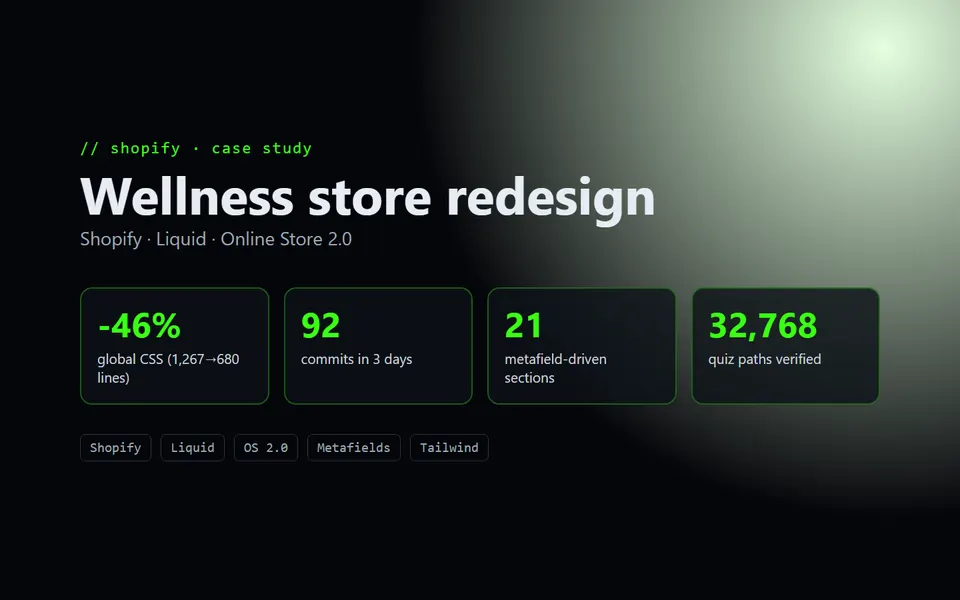
Shreyash Tripathi refactored the theme and then redesigned the key pages in 92 commits over three days, keeping the store running throughout.
How it works
Refactor
Moved 2,114 lines of hand-written CSS out of the vendor Tailwind build, pulled inline CSS and JS out of more than 20 sections into named asset files, and removed dead code. Global CSS went from 1,267 to 680 lines.
Scoped styles
Stylesheets now load only on the pages that use them, documented in a codebase and CSS architecture guide.
New sections
A wellness assessment, concern finder, comparison and benefit tables, a claims strip and a press strip, all editable in the theme editor.
Navigation
A restyled header and a shoppable mega menu, plus one shared scroll-reveal motion layer.
Product page
A rebuilt product page with a sticky gallery, accordions and a pack selector; 21 sections and snippets read product metafields such as benefits, ingredients, how-to steps and FAQs.
Challenges & solutions
challenge: Add to Cart always sent quantity 1: the page showed the price for a pack of 3 but charged for a single unit.
solution: Synced pack and quantity both ways, capped quantity at the largest pack, and moved tier pricing to a Shopify automatic discount (0, 15 and 20%).
challenge: The homepage quiz and the find-your-ritual page each had their own copy of 40 weighted rules, so they could disagree.
solution: Merged them into one shared ritual engine and checked all 32,768 answer combinations give identical results.
challenge: Splitting a CSS file by line range caused horizontal scroll on phones, and a closed mega menu was still laid out about 5,300px wide.
solution: Extracted CSS by selector instead of by line, and stopped the closed menu from taking up layout width.
Results
- Global CSS cut from 1,267 to 680 lines with the store live throughout.
- Product page height reduced from 10,164 to 9,457px at desktop width.
- Pack pricing now charges correctly, and the quiz gives one consistent answer everywhere.
What I built
- Global CSS cut nearly in half.
- Rebuilt product page and new sections.
- Fixed pack pricing and unified the quiz.
Tech stack
Ayurvedic Wellness Store is built with Shopify, Liquid, Online Store 2.0, Metafields, Tailwind CSS and JavaScript.
- Shopify
- Liquid
- Online Store 2.0
- Metafields
- Tailwind CSS
- JavaScript

About the developer
Shreyash Tripathi is a Full-Stack Developer and UI/UX Engineer in Noida, India, currently Junior Developer, UI/UX at Garage Collective. He builds React, Next.js and TypeScript interfaces for AI-integrated SaaS products.